
For shoppers, the news raises very practical questions. Is Rebel ice cream disappearing from stores? Why can a packaging similarity cost a company nearly $24 million? And what does any of this mean for the separate class action that challenged Rebel's health-focused marketing? This guide walks through the entire Rebel Creamery ice cream lawsuit from beginning to end: the origins of both brands, the evidence that convinced the court, how the damages figure was calculated, what the bankruptcy changes, and what is likely to happen next on appeal.
Everything below is drawn from court filings, the July 2026 judicial opinion, and on-the-record reporting. Where the public record is incomplete — such as the future of the appeal — that is clearly labeled as analysis rather than fact.
Table of Contents
- The Short Answer: What Happened in the Rebel Creamery Ice Cream Lawsuit
- Key Facts at a Glance
- Two Pint Brands on a Collision Course
- Rebel Creamery Lawsuit Timeline
- What Is Trade Dress, and What Did Van Leeuwen Claim?
- The Evidence That Convinced the Court
- Why Rebel's Defenses Collapsed
- How the $23.8 Million Award Was Calculated
- The Redesign Order: What Happens to Rebel's Pints Now
- Rebel Creamery's Chapter 11 Bankruptcy, Explained
- The Other Lawsuit: Davis v. Rebel Creamery Class Action
- What the Case Means for Food and Beverage Brands
- What Shoppers Should Expect in the Freezer Aisle
- Frequently Asked Questions
- The Bottom Line
The Short Answer: What Happened in the Rebel Creamery Ice Cream Lawsuit
The Rebel Creamery ice cream lawsuit is actually two separate legal battles, but the one that made headlines is Van Leeuwen Ice Cream LLC v. Rebel Creamery LLC, a trade dress infringement case filed in 2021 in the U.S. District Court for the Eastern District of New York. Van Leeuwen — the Brooklyn premium ice cream brand known for monochromatic pastel pints with black script lettering — accused Rebel of launching look-alike packaging that confused shoppers. After a bench trial, U.S. District Judge Eric Komitee ruled on July 16, 2026 that Rebel had intentionally infringed and diluted Van Leeuwen's trade dress, ordered Rebel to disgorge $23.785 million in profits, permanently enjoined the company from selling the infringing packaging, and ordered a redesign that creates a "substantially different commercial impression."
Rebel appealed on August 12, 2026, and filed for Chapter 11 bankruptcy in Utah on August 14, 2026, listing the judgment as a disputed debt. The bankruptcy's automatic stay pauses collection efforts while Rebel reorganizes and pursues its appeal. Separately, a 2022 consumer class action, Davis v. Rebel Creamery, challenged the company's health-focused marketing in California federal court — a smaller case, but an important part of the company's legal story.
- Who won: Van Leeuwen Ice Cream, on all major claims.
- The award: $23.785 million in disgorged profits (Van Leeuwen had sought $36.4 million).
- The injunction: Rebel must stop selling the infringing pints and redesign its packaging.
- Current status (as of mid-August 2026): Judgment under appeal to the U.S. Court of Appeals; Rebel in Chapter 11 reorganization in Utah.
Key Facts at a Glance
| Fact | Detail |
|---|---|
| Case name | Van Leeuwen Ice Cream LLC v. Rebel Creamery LLC, No. 1:21-cv-02356 |
| Court | U.S. District Court for the Eastern District of New York (Brooklyn) |
| Judge | U.S. District Judge Eric Komitee |
| Filed | April 2021 |
| Ruling date | July 16, 2026, after a bench trial |
| Core finding | Rebel intentionally infringed and diluted Van Leeuwen's trade dress |
| Monetary award | $23.785 million in disgorged profits |
| Other relief | Permanent injunction plus a mandatory packaging redesign |
| Appeal | Notice of appeal filed August 12, 2026 |
| Bankruptcy | Chapter 11 petition filed August 14, 2026, U.S. Bankruptcy Court for the District of Utah |
| Related consumer case | Davis v. Rebel Creamery LLC, No. 3:22-cv-04111 (N.D. Cal.), filed July 13, 2022 |
Two Pint Brands on a Collision Course
To understand why a packaging dispute escalated into a nine-figure-scale business crisis, it helps to understand the two companies involved. They are very different brands that ended up looking almost identical on a freezer shelf.
Van Leeuwen: The Brooklyn Original
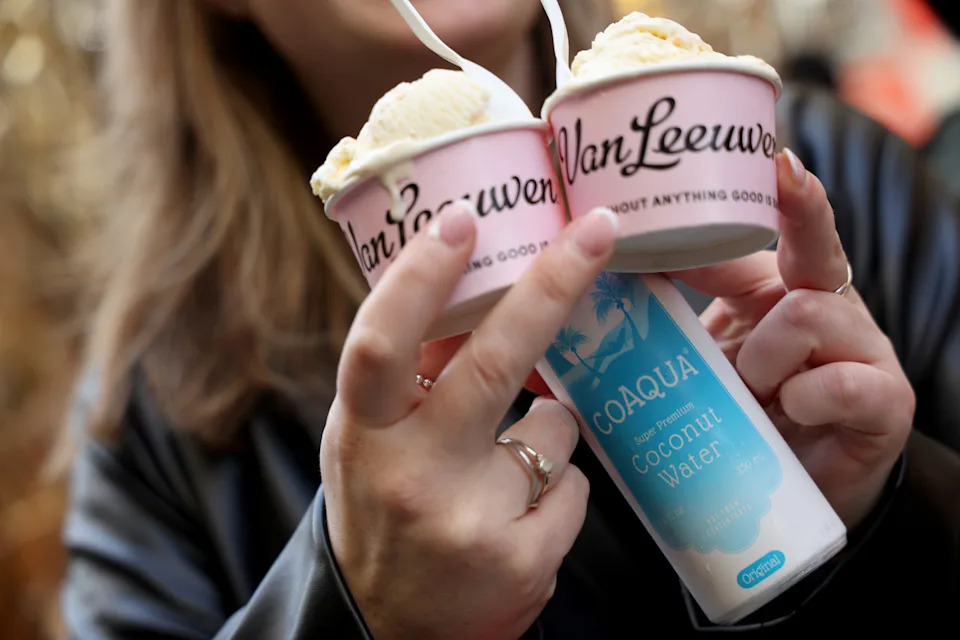
Van Leeuwen was founded in New York City in 2008 and grew from a yellow ice cream truck into a nationally distributed premium brand with scoop shops across the country. The packaging at the heart of the case arrived in 2016, when the company hired the renowned design firm Pentagram to prepare the brand for national wholesale distribution. Pentagram partner Natasha Jen led the project, researching competing brands and presenting seven distinct concepts before the founders selected the final look: a single-color cardboard pint with a matching lid, soft pastel shades, black script lettering with an exaggerated capital letter, and an intentionally spare, minimalist layout.
The redesign was a commercial success. According to legal commentary on the case, Van Leeuwen's sales and sales velocity rose nearly 50% within the first six months after the new look launched. Just as important for the eventual trial, Pentagram kept everything: the briefs, the presentations, the design files, the rejected concepts, and the successive rounds of revisions. That paper trail would later become one of the most powerful exhibits in the case.
Rebel Creamery: The Keto Challenger
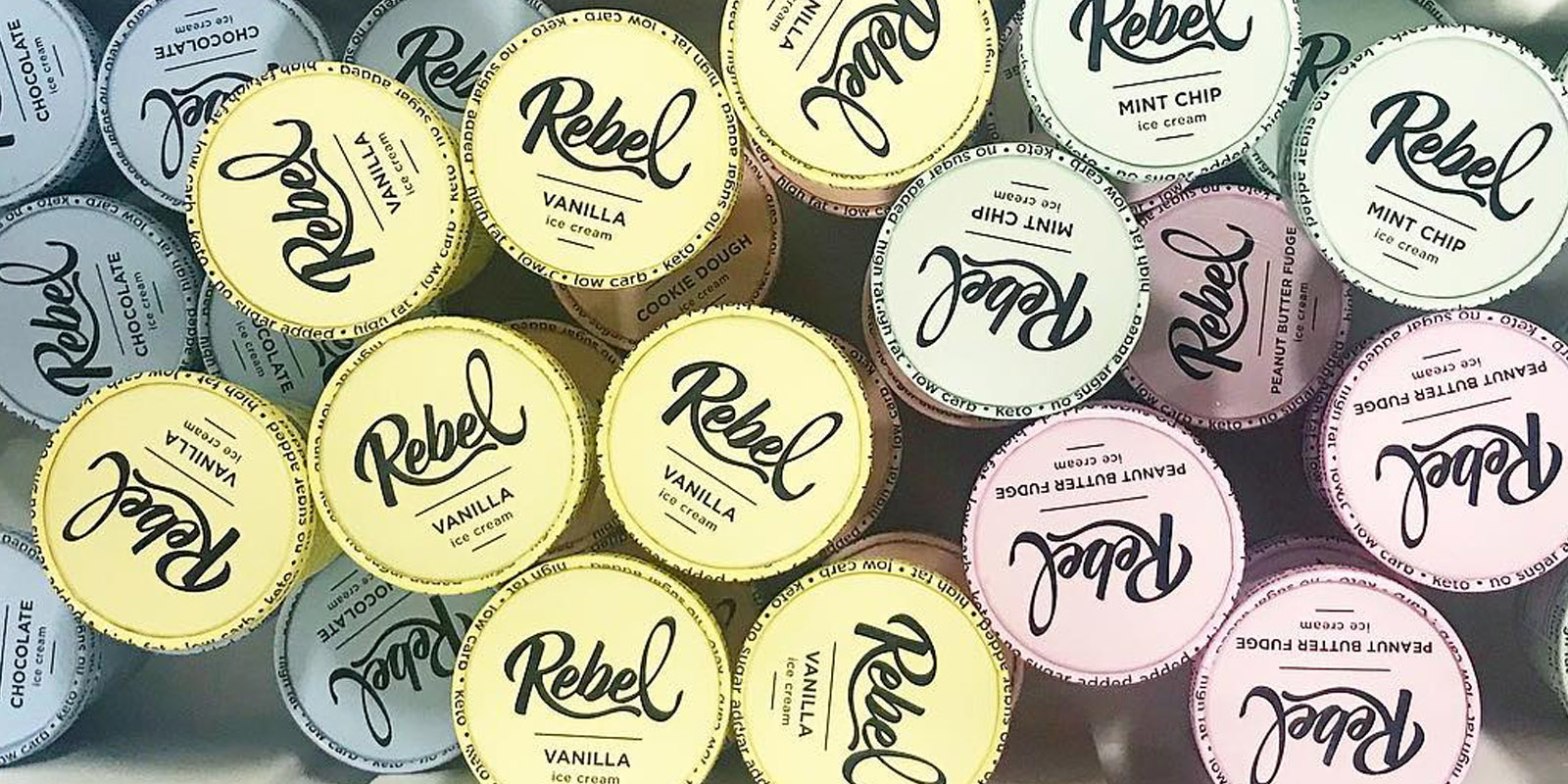
Rebel Creamery emerged from a completely different corner of the market. Founders Austin and Courtney Archibald, a Utah couple who had adopted a ketogenic lifestyle in 2017, wanted an ice cream that fit a high-fat, low-carb diet, and they launched Rebel with a Kickstarter campaign that same year. The company, now based in Midway, Utah, built its identity around being the first high-fat, low-carb, no-sugar-added ice cream, with pints carrying net-carb callouts and "keto" messaging around the lid. Rebel's products reached store shelves around August 2018 and eventually landed national placement at major retailers including Walmart, Kroger, and Target.
The problem, Van Leeuwen argued, was not the recipe. It was the carton. Rebel's pints used the same visual formula — monochromatic pastel cartons, matching lids, oversized black script, minimalist layout — that Van Leeuwen had established two years earlier. On a freezer shelf, the two brands were nearly indistinguishable at a glance, even though one was a premium dairy brand and the other a keto-focused product.

Rebel Creamery Lawsuit Timeline
The dispute unfolded over nearly eight years, from first sightings of the Rebel pint to the bankruptcy filing. Here is the chronology based on court documents and reporting:
| Date | Event |
|---|---|
| 2008 | Van Leeuwen is founded in New York City. |
| 2016 | Van Leeuwen rolls out its Pentagram-designed pastel pint packaging for national distribution. |
| 2017 | Austin and Courtney Archibald found Rebel Creamery in Utah and launch it via Kickstarter. |
| August 2018 | Rebel pints begin appearing in stores. |
| Late 2018 / early 2019 | A Van Leeuwen employee spots Rebel's packaging on social media; the founders are shocked by the similarity but delay suing because the company has little money and has never litigated. |
| April 2021 | Van Leeuwen files suit in the Eastern District of New York (No. 1:21-cv-02356). |
| July 13, 2022 | Separately, consumers file the Davis class action over health marketing in Northern California (No. 3:22-cv-04111). |
| March 2023 | Magistrate Judge Thomas Hixson largely lets the Davis labeling claims proceed while rejecting the plaintiffs' online-advertising allegations. |
| March 2024 | Judge Komitee grants Rebel's motion to strike Van Leeuwen's jury demand, ruling that Van Leeuwen abandoned its legal claims; the case proceeds as a bench trial on equitable claims. |
| August 2024 | A consumer writes to Rebel describing how her husband brought home Rebel instead of Van Leeuwen — an email later cited as evidence of actual confusion. |
| July 16, 2026 | After a bench trial, Judge Komitee rules for Van Leeuwen: $23.785 million disgorgement, permanent injunction, and a mandatory redesign. |
| August 12, 2026 | Rebel files a notice of appeal to the U.S. Court of Appeals. |
| August 14, 2026 | Rebel files for Chapter 11 bankruptcy in the U.S. Bankruptcy Court for the District of Utah, listing the judgment as a disputed debt. |
What Is Trade Dress, and What Did Van Leeuwen Claim?
Trade dress is the overall visual impression of a product or its packaging — the combination of shape, color, typography, and layout that signals to consumers where a product comes from. Unlike a trademark, it protects the look rather than a name or logo. Crucially, Van Leeuwen never argued that Rebel copied its name or logo. The case was entirely about the total commercial impression created by the pint.
The court defined Van Leeuwen's protectable trade dress as a combination of four elements:
- A monochromatic cardboard pint with a matching monochromatic lid.
- A soft pastel color palette.
- Black script lettering with an exaggerated capital letter.
- An overall minimalist design aesthetic with little else on the carton.
The Legal Claims
Van Leeuwen's complaint asserted false designation of origin, unfair competition, and trade dress infringement under the federal Lanham Act; reverse confusion under the Lanham Act; common law trade dress infringement and unfair competition; and trademark dilution under New York law. The reverse confusion theory is especially important to this story. In a classic confusion case, a small copycat rides on a famous brand's reputation. In a reverse confusion case, a larger or fast-growing newcomer saturates the market with a similar look, leading shoppers to believe the original brand is connected to — or even a copy of — the newcomer. Van Leeuwen argued that Rebel's expansion into major retail chains threatened exactly that.
Why the Combination Matters More Than the Parts
Rebel's central defense was that each individual element — pastel colors, script fonts, minimal layouts — is common in the food industry and therefore free for anyone to use. The court rejected that framing. Trade dress protection, Judge Komitee explained, extends to the combination of elements and the overall commercial impression they create, not to each component in isolation. Even if particular colors or fonts appear elsewhere in the marketplace, the combination can be protectable once it has acquired distinctiveness — meaning consumers have come to associate that look with a single source. Van Leeuwen's 2016 launch, its design firm's research, and the sharp sales increase after the redesign all supported that finding.
The Evidence That Convinced the Court
Trade dress cases often live or die on evidence of real-world confusion, and this case produced several vivid examples.
The Customer Email
In August 2024, a woman wrote to Rebel Creamery to complain — about her husband. She had sent him to the store for Van Leeuwen ice cream, and he came home with Rebel. "Your product was placed right next to Van Leeuwen and looked the same," she wrote, adding that she had nearly made the same mistake herself, and that a friend on the other side of the country had shared the identical experience. That email was introduced at trial as direct evidence of actual consumer confusion.
Store Employees and Retail Buyers
Confusion was not limited to shoppers. Trial evidence showed store employees mixing the brands up, putting Rebel price tags on Van Leeuwen pints and shelving the two brands together. According to legal commentary on the proceedings, a buyer for the Wegmans grocery chain had raised concerns about the similarity before Rebel's launch, and another major retail chain told the companies it could not carry both brands because the trade dress was too similar. Retailer testimony like this is powerful because buyers are sophisticated observers of the freezer aisle.

The Survey: 34.3% Net Confusion
Van Leeuwen also retained the consulting firm Keegan & Donato to run a reverse confusion trade dress survey. Its expert, Mark Keegan, testified about the survey's design and methodology, and according to reporting on the trial, the survey found a 34.3% net confusion rate — roughly a third of surveyed ice cream shoppers associated the packaging with the wrong brand. Courts generally treat properly administered consumer surveys as some of the strongest evidence of likely confusion, and a net confusion rate above roughly 25–30% is widely regarded in trademark practice as substantial.
The Reverse Confusion Finding
The court accepted that Rebel's growth into national retailers created a risk that consumers and buyers would come to believe Van Leeuwen was associated with Rebel, diluting the distinctiveness of Van Leeuwen's look. That finding mattered both for liability and for the remedy: it framed Rebel's packaging not as a harmless aesthetic choice but as a threat to the source-identifying power of Van Leeuwen's brand.
Why Rebel's Defenses Collapsed
Rebel did not simply lose on the similarity question. The court also rejected the company's core defenses in unusually strong language, and the reasons are instructive for any business.
The Missing Paper Trail
Rebel's founders testified that they had designed the packaging themselves in Adobe Illustrator. But the company produced no sketches, no mockups, no earlier drafts, no rejected concepts, and no internal emails discussing design direction — only the finished artwork. Van Leeuwen, by contrast, could show a complete, contemporaneous design history through Pentagram: briefs, seven concepts, successive revisions, and final selection. Judge Komitee concluded that Rebel's story of independent creation was "clearly fabricated," calling the probability of innocent coincidence "infinitesimal." In a trade dress case, the design process is the evidence, and Rebel had none.
The Good Faith Remote User Defense Failed
Rebel also asserted the Lanham Act's good faith remote user defense, which protects a business that independently adopts a mark or trade dress in a geographically remote market before learning of another user's rights. The defense has two requirements: good faith adoption and geographic remoteness. The court found that Rebel satisfied neither. Given the findings about how Rebel's packaging came to exist, good faith was impossible to establish, and Rebel could not show the kind of remote, isolated market the defense contemplates in an era of national e-commerce and social media.
The Intent Finding Changed Everything
Intent is not required to win a trade dress case, but it transforms the remedies analysis. "The evidence at that trial left no doubt that Rebel infringed and diluted Van Leeuwen's trade dress and did so intentionally," Judge Komitee wrote. That finding made disgorgement of profits and a broad injunction far easier to justify — and it is a large part of why the monetary award reached eight figures.

How the $23.8 Million Award Was Calculated
The headline number — $23,785,000 — is a disgorgement of Rebel's profits, not a measure of Van Leeuwen's losses. That distinction is central to how the Lanham Act works. Disgorgement asks what the infringer gained from the wrongful conduct, on the theory that a deliberate infringer should not retain the fruits of its infringement.
The statute sets up a burden-shifting framework. Once the plaintiff proves the defendant's gross revenue from the infringing products, the burden shifts to the defendant to prove deductible expenses and to show what portion of its profits, if any, came from factors other than the infringement. Here is how the math played out:
- Van Leeuwen's request: $36.4 million.
- The court's profit finding: roughly $35.5 million in Rebel profits attributable to the infringing pints.
- The reduction: the court accepted that some share of Rebel's sales was driven by demand for keto ice cream rather than by the packaging, and cut the figure by about one-third.
- The final award: $23.785 million.
- Rebel's position: that it should owe no more than $5 million — an argument the court rejected because nothing in the record supported it.
The lesson in the arithmetic is about burden of proof. Rebel successfully argued for a one-third reduction by showing that its "better-for-you" positioning independently drove demand. But it failed to prove any larger apportionment, so the uncertainty redounded to the infringer's disadvantage. That is how a company with roughly $13.78 million in reported assets ended up on the hook for nearly $24 million.
The Redesign Order: What Happens to Rebel's Pints Now
Money was only half the remedy. Judge Komitee permanently enjoined Rebel from selling products bearing packaging likely to be confused with Van Leeuwen's trade dress and ordered the company to redesign its pints so they create "a substantially different commercial impression." That standard does not require Rebel to abandon pastel colors or script fonts entirely — trade dress law does not give any company a monopoly over a color or a typeface. It requires the overall impression to change enough that an ordinary shopper, glancing at a freezer case, would no longer associate the two brands.
In practical terms, that likely means rethinking several elements at once: the monochrome carton-and-lid system, the scale and style of the script, the amount of additional design content on the carton, and the color strategy. Whether the redesign happens soon depends on the appeal and the bankruptcy, which brings us to the newest chapter of the story.
Rebel Creamery's Chapter 11 Bankruptcy, Explained
On August 14, 2026 — two days after noticing its appeal — Rebel Creamery LLC filed a voluntary Chapter 11 petition in the U.S. Bankruptcy Court for the District of Utah. The petition listed the company's assets and liabilities in the $10 million to $50 million range, and reported figures show approximately $13.78 million in assets against $23.85 million in liabilities, including roughly $5.22 million in cash, $2.59 million in receivables, and $5.65 million in inventory. The $23.785 million Van Leeuwen judgment appears in the paperwork as a debt Rebel disputes.
What Chapter 11 Does — and Does Not Do
Chapter 11 is a reorganization statute, not a liquidation. Its core features matter here:
- Automatic stay. Filing immediately stops creditors, including judgment creditors like Van Leeuwen, from collecting while the case proceeds. That is why the $23.785 million cannot simply be seized from Rebel's accounts today.
- Continued operations. Debtors in Chapter 11 typically keep running their business — producing, shipping, and selling product — while they restructure. There is no indication the brand has stopped selling product as a result of the filing.
- A breathing window for the appeal. The stay buys Rebel time to press its Second Circuit appeal without the judgment being enforced against it in the meantime.
- A disputed claim. By listing the judgment as disputed, Rebel preserves its position that it owes nothing, pending appeal or bankruptcy court resolution.
What Could Happen Next
Three tracks now run in parallel, and it is important to label the following as analysis rather than prediction of outcomes:
- The appeal. Rebel will likely challenge the liability findings, the intent finding, and the damages calculation. Appeals of trade dress determinations are fact-intensive and deferential to trial courts on credibility findings, which historically makes them difficult to reverse — but the bankruptcy gives Rebel the runway to try.
- The bankruptcy reorganization. Rebel may seek a plan that pays creditors a fraction of what is owed, a sale of the business or its assets, or a negotiated settlement with Van Leeuwen as the largest creditor. Van Leeuwen's claim effectively gives it a major seat at the restructuring table.
- The redesign. Unless the appeal overturns the injunction, Rebel must eventually ship a redesigned pint. A rebrand inside a bankruptcy is difficult but not unprecedented, and any buyer of Rebel's assets would likely acquire the brand subject to the injunction.
What is not in dispute is the arithmetic that put Rebel in this position: a judgment larger than the company's total reported assets is precisely the kind of debt that pushes a small manufacturer into Chapter 11.
The Other Lawsuit: Davis v. Rebel Creamery Class Action
The trade dress verdict is not the only litigation in Rebel's history. On July 13, 2022, consumers Angela Davis of California and Bonnie Bennett of Michigan filed a proposed class action, Davis v. Rebel Creamery LLC, in the U.S. District Court for the Northern District of California (No. 3:22-cv-04111), alleging that Rebel deceptively marketed its high-fat ice cream as healthy.
The Allegations
The complaint targeted label language stating that eating foods high in "healthy fats" and low in carbs or sugar trains the body to burn fat, and that common benefits of such a diet include weight loss, increased energy, suppressed appetite, and mental clarity. The plaintiffs alleged those claims were false and misleading because Rebel's products contain high amounts of saturated fat, trans fat, and cholesterol — the complaint colorfully noted that every flavor contained more saturated fat per serving than a Burger King cheeseburger, an Arby's roast beef sandwich, a KFC fried chicken breast, or three large orders of McDonald's fries. The suit asserted violations of California's Unfair Competition Law and Consumers Legal Remedies Act, plus breach of warranty and unjust enrichment, and alleged that Rebel omitted mandatory disclosure language that would put its nutrient content claims in context.
Where the Case Stood
In March 2023, U.S. Magistrate Judge Thomas Hixson issued a mixed ruling on Rebel's motion to dismiss. The plaintiffs were on solid ground regarding the labeling on the products themselves, the magistrate found, but their allegations about online advertising fell short because they failed to identify specific online statements they relied upon; that portion was rejected with an opportunity to amend. The labeling-based claims therefore proceeded.
Later docket entries refer to the plaintiffs' "former class-action claims," indicating the case continued to evolve after 2023, but the public record reviewed for this article does not establish a final settlement or disposition. Readers who purchased Rebel products and want to know whether any consumer payment or claim process exists should check the official court docket or reputable class action tracking resources rather than relying on social media posts, which have repeatedly overstated the case's status.
How the Two Cases Differ
| Aspect | Van Leeuwen v. Rebel (Trade Dress) | Davis v. Rebel (Consumer Class Action) |
|---|---|---|
| Plaintiff | A competing ice cream company | Consumers (proposed class) |
| Core grievance | Copied packaging and brand identity | Allegedly misleading health marketing |
| Legal basis | Lanham Act, New York dilution law, common law | California consumer protection statutes, warranty, unjust enrichment |
| Outcome so far | $23.785 million judgment plus injunction (on appeal) | Labeling claims allowed to proceed in 2023; later status unconfirmed in public record |
| Direct impact on shoppers | Packaging redesign; brand availability questions | Potential consumer remedies only if the case resolves with a settlement or judgment |
What the Case Means for Food and Beverage Brands
Legal analysts have treated the ruling as a landmark reminder that packaging is a legal asset as much as a marketing asset. Several practical lessons stand out:
- Protect the combination, not just the logo. Van Leeuwen won without alleging copying of its name or logo. The overall commercial impression — monochrome pint, pastel palette, black script, minimalism — was the protected asset.
- Document the design process. Pentagram's retained briefs, concepts, and revisions proved independent creation. Rebel's absence of any process documentation was fatal to its good faith story. Your design files are future litigation exhibits.
- Take retailer warnings seriously. Pre-launch concerns from buyers about similarity to a competitor are early notice of confusion risk. Ignoring them can convert an arguable coincidence into evidence of intent.
- Surveys decide close cases. A well-administered consumer survey showing a 34.3% net confusion rate gave the court concrete, quantified evidence of likely confusion alongside anecdotal emails and employee errors.
- Disgorgement can exceed the value of the company. Profit disgorgement measures the infringer's gain, and once gross revenue is shown, the burden of apportionment shifts to the defendant. Rebel's failure to prove a larger apportionment turned a successful keto brand into an insolvent judgment debtor.
- "Different name, different product" is not a shield. The court rejected the argument that keto-focused shoppers could not be confused, noting the brands shared retail channels and that shoppers buy on overall visual impression.
What Shoppers Should Expect in the Freezer Aisle
For the people who actually buy the ice cream, a few grounded points are worth making, with the caveat that retail situations can change quickly during a bankruptcy:
- Rebel ice cream has not been recalled. Neither lawsuit involves food safety. The trade dress case is about packaging similarity, and the class action challenged marketing language, not contamination or ingredients labeling errors of the safety variety.
- Chapter 11 usually means continued operations. Reorganization is designed to let a business keep producing and selling while it restructures, so existing stock and ongoing production can remain on shelves during the case.
- The packaging must change unless the appeal succeeds. The injunction requires a redesign producing a substantially different commercial impression, so long-time buyers may eventually see a visually different Rebel pint.
- Availability depends on retailers and restructuring. Shelf space decisions during a supplier's bankruptcy are made by retailers, and distribution can vary by chain and region. Anyone relying on Rebel for dietary planning should watch their local retailer's assortment in the coming months.
- Watch the docket, not the memes. Social media coverage has blended the trade dress judgment, the bankruptcy, and the older class action into a single story. They are separate proceedings with separate statuses.
Frequently Asked Questions
What is the Rebel Creamery ice cream lawsuit in simple terms?
It is a trade dress lawsuit in which Van Leeuwen Ice Cream accused Rebel Creamery of copying its minimalist pastel pint packaging. A federal judge in Brooklyn agreed in July 2026, ordering Rebel to pay $23.785 million in profits and to redesign its packaging. Rebel appealed and then filed for Chapter 11 bankruptcy, listing the judgment as a disputed debt.
Did the court find that Rebel copied Van Leeuwen on purpose?
Yes. Judge Eric Komitee wrote that the evidence "left no doubt" Rebel infringed and diluted Van Leeuwen's trade dress intentionally. The court rejected Rebel's independent-creation story as "clearly fabricated," noting the company produced no design sketches, drafts, or emails while Van Leeuwen had a complete Pentagram paper trail.
How much does Rebel Creamery have to pay?
The judgment is $23,785,000 in disgorged profits. Van Leeuwen sought $36.4 million; the court found roughly $35.5 million in profits and cut about one-third because some sales came from keto demand rather than the packaging. Whether Rebel ultimately pays — and how much — now depends on the appeal and the bankruptcy.
Is Rebel Creamery going out of business?
Not necessarily. Chapter 11 is reorganization, not liquidation, and debtors typically keep operating during the process. However, the company reported about $13.78 million in assets against $23.85 million in liabilities, so its future may involve a restructuring, a sale, or a settlement with Van Leeuwen. As of mid-August 2026, no liquidation has been announced.
Will Rebel ice cream still be sold in stores?
Rebel pints remained in retail channels around the time of the filing, and Chapter 11 is structured to let businesses continue selling while they reorganize. Shelf presence is ultimately a retailer decision, so availability can vary by chain and region during the bankruptcy. The packaging itself must change unless the appeal overturns the injunction.
Was Rebel Creamery also sued over health claims?
Yes. A 2022 class action, Davis v. Rebel Creamery, alleged the brand misleadingly marketed high-saturated-fat ice cream as healthy. In March 2023, a magistrate judge let the labeling-based claims proceed while rejecting the online-advertising allegations. The public record reviewed here does not confirm a final settlement or disposition.
What is trade dress, and how is it different from a trademark?
A trademark protects names, logos, and slogans. Trade dress protects the overall look of a product or its packaging — colors, shapes, typography, and layout as a combination — once that look identifies the product's source to consumers. Van Leeuwen won without claiming its name or logo was copied; the pint's total visual impression was the protected asset.
The Bottom Line
The Rebel Creamery ice cream lawsuit is now a textbook case in American branding law. A small keto challenger adopted the visual grammar of a premium incumbent — monochrome pastel pints, matching lids, black script, minimalist restraint — and a federal judge concluded the similarity was no accident. The result was a $23.785 million disgorgement award, a mandatory redesign, a permanent injunction, an appeal, and a Chapter 11 filing, all flowing from the way a cardboard pint looks in a freezer case.
For competitors, the message is that overall commercial impression is protectable, and that design documentation is litigation insurance. For shoppers, the message is simpler: the ice cream itself was never the legal problem, the brand's future is now being worked out in a Utah bankruptcy court and a New York appellate court, and the pastel pints that started it all will have to change unless the appeal rewrites the ruling. This is a developing story, and the appeal and bankruptcy dockets — not headlines — will determine how it ends.
If you found this explainer useful, share it with fellow ice cream lovers, and check back as the appeal and bankruptcy proceedings progress — we will keep tracking what the Rebel Creamery ice cream lawsuit means for the brand, the freezer aisle, and the law of trade dress.